The Business Is Not Transferable If Every Decision Still Comes Back To You
Most founder dependency does not show up first in the work. It shows up in the decisions. A buyer does not just want to know that the business can do the work. They want confidence that it can keep making good decisions without the founder in the middle.
View the transferability diagramWho approves the price? Who handles the difficult customer? Who decides whether to hire? Who signs off extra spending? Who deals with supplier issues? Who approves project changes? Who makes the call when the answer is not obvious? In too many businesses, the real answer is still the founder. And that is a problem, not just for time, not just for scale, not just for stress, but for value.
Buyers do not just ask how profitable the business is. They ask if that profit will continue when the founder is gone.
Revenue Is Good. Transferability Is Better.
A business can have good revenue, good customers, good people, good margins and good history, and still be difficult to sell, scale or transition. Why? Because too much still lives inside the founder's head.
The founder knows the customers. The founder knows the pricing logic. The founder knows which jobs to take and which ones to avoid. The founder knows which supplier can be trusted. The founder knows when a project is going wrong before anyone else sees it.
That experience is valuable. But if it is not transferred into the business, it becomes a risk. From the outside, the business may look strong. But underneath, the founder is still the operating system. That is where buyers get nervous.
The Founder Is Often the Routing Layer
In many owner-managed businesses, the founder becomes the routing layer for everything important. The work moves through the team. But the decisions move through the founder. That creates a hidden dependency.
People may be busy. Customers may be happy. Revenue may be growing. But underneath, the business is still waiting for the founder to approve, confirm, correct, rescue or decide. That means the business is not truly self-managing. It is founder-managed with extra people around it.
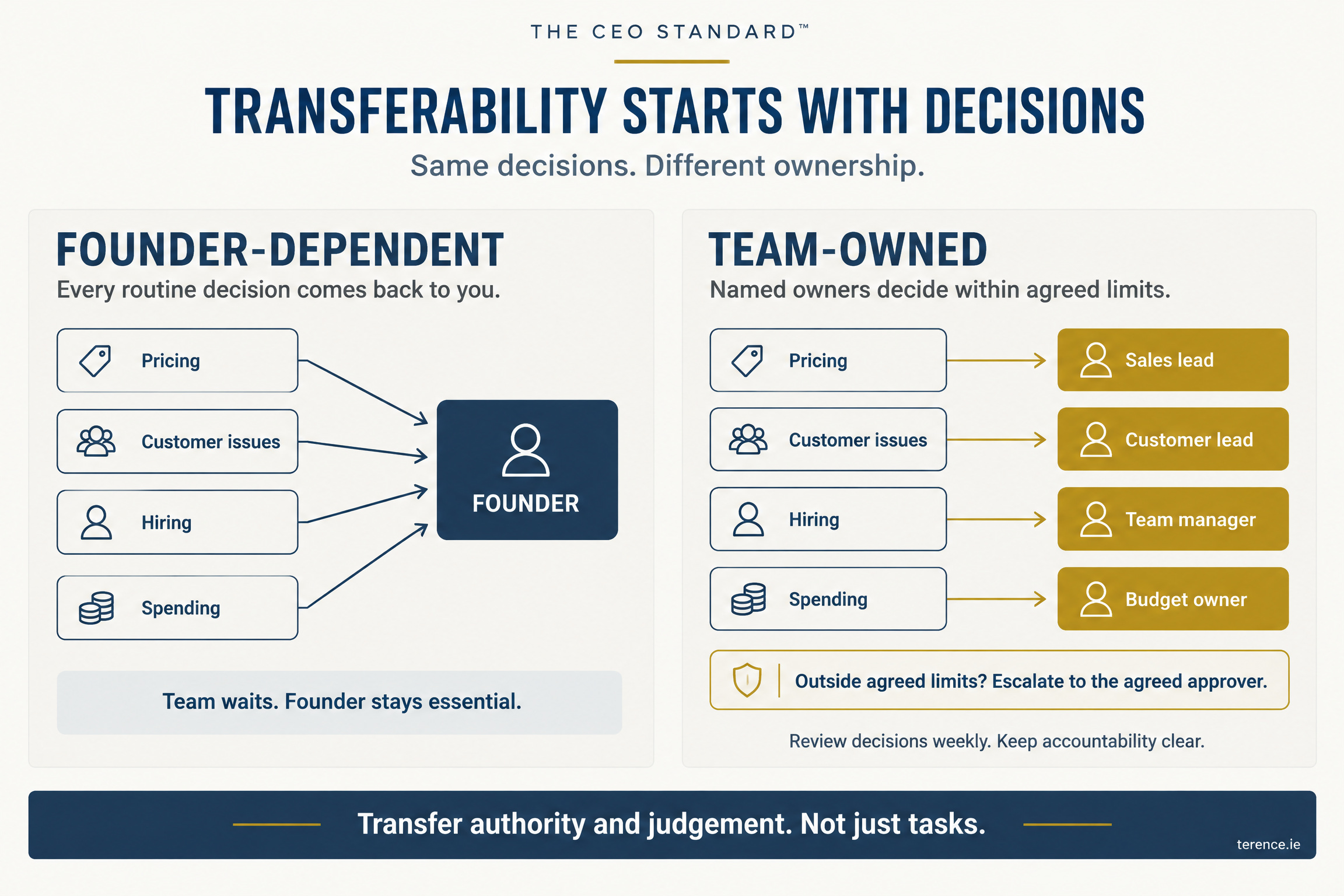
Transfer authority and judgement, not just tasks. Named owners make routine decisions within agreed limits; exceptions go to the agreed approver.
Tap or click the image to open a larger view. On a phone, you can pinch to zoom in that view.
Read the diagram in text
Founder-dependent: pricing, customer issues, hiring and spending all require the founder's approval. The team waits and the founder stays essential. Team-owned: pricing goes to the sales lead, customer issues to the customer lead, hiring to the team manager and spending to the budget owner. These are illustrative role assignments, not universal job titles. Each owner decides within agreed authority and risk limits. Anything outside those limits is escalated to the agreed approver. Decisions are reviewed weekly and accountability stays clear.
Every unclear decision creates delay. Every delay creates pressure. Every pressure point creates escalation. Every escalation comes back to the founder. And every time the founder solves it, the system gets weaker, not stronger.
5 Things To Start Doing Immediately
Build Decision-Making Capability
3 Critical Mistakes To Avoid
Common Mistakes
7-Point Action Checklist
- .Write down the top 10 decisions that came back to you in the last 30 days
- .Identify which decisions should already be owned by someone else
- .Create a simple decision matrix for pricing, customer issues, hiring, cash and operational changes
- .Set clear approval limits for your leadership team
- .Define what must be escalated and what should not be escalated
- .Ask each manager: what decision do you still come to me for that you should be able to make yourself?
- .Review decisions weekly until the business starts making better calls without you in the middle
Final Thought
The first system a founder should document is not always the full operations manual. It is the decision-making system. Because that is where dependency usually lives, not in the obvious work, but in the judgement, in the approvals, in the exceptions, in the commercial calls, in the moments when people are unsure and look back to the founder for the answer.
A founder-led business becomes more valuable when decisions no longer depend on the founder being in the room. That does not mean the founder becomes irrelevant. It means the business becomes stronger. It means the team can think. It means managers can lead. It means buyers can see transferability.
Buyers do not just buy what the business earned yesterday. They buy confidence in what it can keep earning tomorrow. And that confidence comes from systems, leadership and transferable decision-making. That is what it means to be Built to Run Without You.
Put This Into Practice
Find Where Your Business Is Stuck
The CEO Scorecard gives you a clear view of the constraints affecting profit, cash, the team and your time.
Continue Reading
Back to all articles